
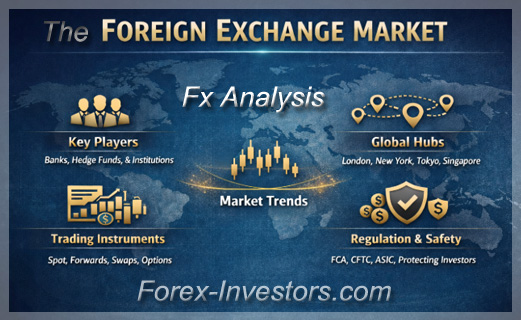
The Foreign Exchange market is the largest and most liquid financial market in the world. A fully decentralized market that moves across 3 different time zones, 24 hours a day, five days a week. Whether you are a small ECN trader in Asia opening a speculative position on the Eurodollar or a large institutional investor in London executing $1 billion USD in OTC swaps, you are participating in this decentralized architecture. The activity in each different time zone plays a distinct role in the process of currency trading:
- Asia session ⇒ sets early liquidity in the Forex Market
- London session ⇒ creates early trends (volume surge)
- New York session ⇒ resolves (completes) trends set earlier
The Fundamental Architecture of the Forex Market
The operation of the Forex market is based on an over-the-counter (OTC) model, meaning there is no central exchange like there is for stocks (e.g., NASDAQ) or futures products (e.g., CME). Instead, daily activity is conducted via electronic platforms that match liquidity.
- The Bank for International Settlements’ (BIS) Triennial Survey reported a record average daily FX turnover in April 2025, exceeding USD 9.6 trillion (FX swaps, spot trades, forwards, and options all contributing to that massive volume).
Currency Transactions Flows
The flow of transactions in the Forex market is routed through:
- Interbank Networks -International banks trading directly with each other
- ECNs & Dealer platforms -Institutional trading through order matching
- Electronic Services -For example, Reuters/Refinitiv access
- Retail Brokerage -Aggregated retail execution
This multi-layered structure of the Forex market ensures global access, high liquidity, and tight spreads for all participants.
Geographic Distribution -Global Hubs
According to BIS industry reports, this is the geographic distribution of Forex trading volumes:
- United Kingdom - ~38-43 % of FX activity, EU and global hub
- United States - ~19-20 %, important for USD liquidity and institutional flows
- Singapore - ~11-12 % and growing, eclipsing Hong Kong as the leading Asia-Pacific center
- Hong Kong - ~7 % with strong China-linked flows
Other regions like the Middle East & Africa contribute modestly (~6 %), while Latin America is witnessing rapid growth, driven by volatility and hedging needs.

Key Financial Instruments in the Foreign Exchange Market & Forex Brokers
In the latest BIS Survey, FX swaps fully dominate the Foreign Exchange market’s daily turnover. Moreover, the participation of Spot FX and Outright Forwards have risen, due to increasing hedging and speculative behavior.
Table: Forex Instruments and Shares
|
Instrument |
Function |
Typical Usage |
Market Share |
|
Immediate currency exchange |
Liquidity trading, price discovery |
31% |
|
Exchange currencies now and reverse later |
Short-term funding, hedging |
42% |
|
Lock exchange rate for future delivery |
Hedging currency risk |
19% |
|
Right (not obligation) to exchange |
Volatility hedging, strategic positioning |
7% |
Spot Fx -Forex Brokers by Estimated Trading Volume (2025)
These are some top Forex brokers based on their trading volumes:
- Exness -Known for tight spreads, deep liquidity, and widespread retail usage
- IC Markets -One of the largest ECN-brokers globally, consistently reporting very high monthly volume
- XM Group -Major global broker with significant participation, particularly in Asia, Africa, and the Middle East
- com (StoneX Group) -A key player, especially in the U.S.
- Saxo Bank -Institutional-grade broker with deep liquidity and strong multi-asset execution
- HFM (formerly HotForex) -Strong volume presence and broad global reach
- OANDA -Long-established global broker with substantial daily trading volume in both retail and institutional markets.
- AvaTrade -Veteran multi-regulated broker with substantial activity in the retail market
- IG Group -Global brokerage with significant FX and CFD volumes, especially across Europe and Asia
- Pepperstone -Popular with algorithmic and high-frequency traders
- FxPro -Global reach and multi-platform support broker
Structural Dynamics
Major Players in the Forex Market include central and commercial banks, investment firms, large multinational companies, brokers, dealers, and retail investors and traders:
- Central Banks ⇒ Influence currency values through: monetary policy (interest rate decisions), direct market interventions, and reserve management.
- Commercial and Investment Banks ⇒ The backbone of FX liquidity: handle client flow, execute proprietary trading, and provide bid/ask spreads.
According to the latest Euromoney data and BIS surveys, the top FX trading banks collectively control a significant share of global FX volume, with names like Deutsche Bank, UBS, JPMorgan, Citi, and HSBC regularly showing up near the top of volume rankings.
Shares of Currencies in the Forex Market
Currencies don’t move in isolation. They are part of a network of cross-market relationships. The US dollar appears on roughly 89 % of FX transactions, affirming its central role in global liquidity. Note that the percentages don’t add to 100% because each FX transaction includes two currencies (e.g., a USD/CHF trade counts once for USD and once for CHF).
Table: Shares of currencies in the Forex Market
|
Currency |
Share of Global FX Turnover |
|
89.2 % - by far the dominant currency in global FX trading |
|
28.9 % - second largest, though trending slightly lower vs prior surveys |
|
16.8 % - stable over recent cycles |
|
10.2 % - down from higher levels in earlier years |
|
8.5 % - continuing a multi-cycle upward trend |
|
6.4 % - has risen modestly in recent surveys |
|
~6.1 % - fairly stable; part of the common “commodity currencies” |
|
~5.8 % - also a “commodity currency” with steady participation |

Regulatory Architecture of the Global Forex Market -Key Authorities, Jurisdictions, and Compensation Schemes
The Foreign Exchange market may be decentralized and over-the-counter, but it is not unregulated. On the contrary, Forex sits at the intersection of banking regulation, capital markets oversight, consumer protection, and systemic risk control. Regulation does not eliminate risk, nor is it designed to-but it defines who may operate, how capital must be handled, and what happens when firms fail.
Table: Regulators and Compensation Schemes
|
Region |
Regulator |
Compensation (*) |
Level of Protection |
|
FCA |
£85,000 (FSCS) |
Very High |
|
ESMA + National |
€20k-€70k |
High |
|
CFTC / NFA |
None |
Very High (but no Compensation) |
|
FINMA |
CHF 100k |
Very High |
|
ASIC |
None |
Strong (but no Compensation) |
|
JFSA |
Investor Fund |
Very High |
|
MAS |
Deposit-only |
Institutional |
|
Various |
None |
Low, but no Compensation |
(*) Note for Forex account compensation: compensation in the event of insolvency refers to insurance policies and regulatory funds designed to reimburse traders if their broker declares bankruptcy.
🔗 More: Brokers for Forex Investors
□ Decoding the Operation and Structure of the Foreign Exchange Market
Forex-Investors.com (c)
Sources:
□ Find More: » Brokers Directory | » Forex Brokers & VIP Accounts | » ECN Forex FAQ | » Forex Managed Accounts


